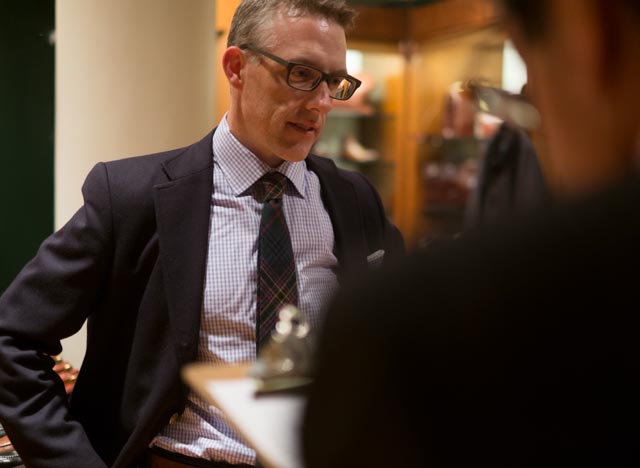
We here at OTC wish to offer up a big, sincere “Thank You,” to everyone who voted and supported our nomination!  OTC’s founder and editor-in-chief, Chris Hogan, made it to the winner’s circle and was crowned “Dandiest at the Derby” by Brooks Brothers’ fans!

Brooks Brothers OTC FB Cover 5.9.12 OTCs Chris Hogan is Brooks Brothers Dandiest

Thanks are also due to our photographer par excellence, Mr. Steven Ritchie, and Mrs. OTC for her invaluable guidance when it comes to ties and choice of image entries (and, frankly, everything else).

Brooks Brothers is an American institution when it comes to classic Ivy League and American preppy styles, but it also leads the way in connecting with a new generation of customers fluent in Facebook, Twitter, blogs, and mobile e-commerce.  While we celebrate and promote the many outstanding start-up and boutique brands helping to redefine the best in menswear and American style, historic and invaluable brands like Brooks Brothers continue to set important benchmarks towards which we all race.

Last year, OTC ran a series of in-depth articles on the history and importance of Brooks Brothers.  Please take a moment and have a read:

Brooks Brothers: American Icon (Part I)
Brooks Brothers: American Icon (Part II)
Brooks Brothers: American Icon (Part III)
Brooks Brothers: American Icon (Part IV)


OTC in Brooks Brothers Contest Finale

We are thrilled to have made it to the final stretch of Brooks Brothers’ “Dandiest at the Derby 2012″ contest!  While we have received some great support from OTC’s family, friends, readers, and supporters, we aren’t taking anything for granted!

And neither are our friends.  Keep reading to learn how you can win too – your very own Frank Clegg coin wallet just for supporting the effort!

431C9921 682x1024 OTC in Brooks Brothers Contest Finale

Even though our support has been strong, there is still one more day of voting on Brooks Brothers’ site, so please make sure to like our photo!

As an added bonus, our good friend master leather designer Frank Clegg is giving away a handmade coin wallet to one lucky winner of his own contest.  To enter, just like our “Dandiest at the Derby 2012″ photo.

So, help OTC take home the brass ring and get yourself a handmade treasure from Frank Clegg!


Preppy: Cultivating Ivy Style

Preppy Cover 226x300 Preppy: Cultivating Ivy StyleWhen first reading my copy of Preppy: Cultivating Ivy Style, I was reminded of how omnipresent the whole preppy thing has become.

OTC hit the internet back in 2005.  Back then, there were very few men’s fashion blogs out there.  And there were even fewer sites dedicated to the preppy/Ivy League/East Coast style so familiar to me.

Over the intervening years, the appeal of preppy style and East Coast lifestyle – at least as seen through the eyes of Lisa Birnbach – gained wider appeal and the proliferation of online experts and opinion-makers ensued.  Back in the 1980s, when The Preppy Handbook first gave birth to a new, aspirational preppy phenomenon, the style was bombastic and over the top, colorful and caricatured.   Today, it’s serious business.  And I mean that both figuratively and literally.

Companies from J. Crew to Ralph Lauren, Brooks Brothers to J. Press are all rediscovering their uber-preppiness.  New smaller brands that fancy themselves cultural artisans and holders of the “true” preppy standard are popping up by the day.  Of all these modern labels only Brooks Brothers, J. Press and L.L. Bean can really lay claim to a physical connection to the genuine preppy aesthetic.  At the same time, many fashion bloggers and armchair fashion historians extol the virtues of being “authentic” focusing on “heritage” brands.

I’ve seen some of this exuberant tut-tutting in the reviews of Preppy: Cultivating Ivy Style and find it a little perplexing.  Some are critical of the book’s lack of historical gravitas and its apparent concession to modern (and apparently blasphemous) interpretations of preppy style.  Too much Ralph Lauren – that’s not authentic prep!  Does that make Polo/Ralph Lauren, founded twilight years of original Preppy, any less preppy?  Is it less authentic?  Of course not, Polo is the bedrock of modern preppy style.

All of this came quickly to mind as I unpacked the book, sent to me through the kindness of its authors, and started to leaf through the pages.  I, and several other bloggers mentioned or quoted in the book have been aware of its development since last year.  When I was contacted for permission to use a quote from my Roots of American Preppy article – for the introduction no less – I was intrigued.  I liked the idea  behind the book and the authors’ approach to creating a modern understanding of the style.

Turns out I also like the book.  Preppy Cover2 225x300 Preppy: Cultivating Ivy StyleIn fact, I think it’s a great resource for anyone looking to better understand and adopt preppy style.  Preppy’s authors, very aware of bloggers’ influence and impact on modern preppy style, also reached out to some of the leading online influencers and mined our archives and writings.  That perspective adds to the larger picture of preppy style today.

I don’t know if some people were expecting the Ivy League equivalent of Alan Flusser’s Dressing The Man -  a book so detailed, complete and authoritative as to garner only criticisms about its obsessive detail.  This book is more of an elegant and somewhat contextual style guide that shows you how to dress and accessorize in the preppy fashion.  It’s not an exhaustive tome dedicated to the intricate nuances of preppy culture and history, pedigree and monogramming rules.  Rather, it is a visual reference for achieving the preppy aesthetic.

Preppy runs the gamut of Ivy League influences and trends, styles, luminaries and brands.  It also goes somewhere most books on this subject do not – to modern times.  Photos from Fred Castleberry are mixed with references to the gritty cool urbanity of Street Etiquette.com.  Modern influences have taken the preppy look in new directions, J.Crew being the standard bearer of the “New Prep.”  In fact, even though J.Crew strives to break its generic “preppy” label, no other brand has so forcefully defined what kids today understand to be preppy.

What makes the preppy style of today so resilient and ubiquitous is that it’s not static – it’s not the old 1980s caricature.  Through style blogs and social media, consumers have decided what they like and how they want to blend looks and even eras.  Creating personal signature looks by blending new and old brands, mass market and small run specialty pieces, old school preppy and new school ironic keeps things fresh.

And that’s the way is should be.  “Real” American preppy has always been about practically, function and quality.  Together, those elements yielded the timeless and classic looks we so covet today.  From bags to dogs, footwear to navy blazers, preppies created a distinctive style by finding what worked, sticking with it and evolving to include new elements that matched their style.  Same thing with this book.

Preppy: Cultivating Ivy Style takes vintage and modern preppy, blends them up and gives us the recipe for achieving a look, a style and, sort of, a life style.  It’s a lovely book and a great addition to a collection or coffee table.


Rake Issue 15 223x300 Alan Flusser (Finally) Profiled in The RakeIssue 15 of The Rake, out now, has a wonderful profile of OTC friend and legendary clothier, Alan Flusser.  Though not available in the United States, The Rake is having a significant impact on the modern meaning and execution of classic American style.

Perhaps the only serious examination of classic menswear and men’s style on the news stand today, The Rake is a rich and intellectual celebration of what its publisher refers to as the “renaissance of gentlemanly sophistication and style.”

With that said, the hefty U.S. subscription fee may very well be worth the outlay.

We are also excited to point out that the article was assembled by two other OTC friends.  Christian Chensvold, founder of Ivy Style and a contributing editor at The Rake, penned the piece.  Fred Castleberry, founder of Unabashedly Prep, took the outstanding photographs.  Both of their sites are knowledge-filled resources for those seeking advice, inspiration and, certainly in Ivy Style’s case, the stories behind East Coast / Ivy League style.

Alan Flusser Thanks to A Suitable Wardrobe 259x300 Alan Flusser (Finally) Profiled in The RakeAlan himself is a wonderful example of how classic style, or as he puts it “permanent fashion,” while timeless is not immutable.  The Custom Shop, Alan’s famous home base in Manhattan, has received a significant face lift and his English drape inspired house silhouette has similarly been refreshed a tad.

Does this mean Flusser is selling out and going for the trendy skinny look?  Not at all.  While the new Flusser drape suit is a touch slimmer and proportionally closer to the body, its inherent comfort, balance, flow and stylistic longevity are very much intact.  Anyone who knows Alan knows that he is far from a stuffed shirt.  His style and personality are equally colorful and expansive.

No slouch on the technical end of things, his BeSpeak and SnapDress iPhone applications are building a growing and devoted audience.  BeSpeak 2.0 is expected to launch later this year with even more functionality.

The Alan Flusser brand may evolving, but he is not changing its core values one bit.

New Flusser2 Luxist 300x199 Alan Flusser (Finally) Profiled in The RakeTo that end, the custom shop’s new streamlined and rakish look evokes Alan’s love of the Art Deco period and his proclivity for personal detail and refined understatement.

To learn more about Alan Flusser, visit the Custom Shop’s website, which itself is getting an overdue refreshing.

To view view The Rake’s article in PDF format, please visit The Rake Compendium, Alan Flusser.


Brooks Brothers: American Icon (Part 4)

Brook Boston 300x245 Brooks Brothers: American Icon (Part 4)This is the fourth part of an extended profile of Brooks Brothers, the iconic and influential American clothing company.  Click here to read Part 3.

BRANCHING OUT

After 114 years, Brooks Brothers opened its first full-sized store outside New York City in 1932.  Located on Newbury Street in Boston, today still the retail heart of the city, the Boston Brooks Brothers store became a landmark in its own right.

Though seasonal outlets in The Hampton’s allowed Brooks to follow its customers while they summered away from the stifling summer heat of the city, these temporary shops closed up at the end of the season.

It wasn’t until 1939 that the first Brooks Brothers stores opened on America’s west coast, in Los Angeles and San Francisco.  Then, in 1946, Brooks was acquired by Washington, D.C.-based specialty store chain Garfinkel-Rhoads, Inc.   The new owners understood what made Brooks tick and wisely left the company to its own devices, rather than mess up a good thing.

1968 marked 150 years of business for Brooks Brothers and the company celebrated by introducing The ‘No. Three’ suit.  With slightly squarer shoulders, definite waist accentuation, subtle flair and a deeper center vent, the No. Three added a more fitted style to the Brooks Brothers’ line-up.

The 1970s marked the start of aggressive expansion for Brooks Brothers.  By the end of the decade, it had doubled to 26 stores.  In 1979, Brooks opened its first Japanese store in Tokyo.  Long fans of Brooks Brothers and Ivy League style, Japanese customers were then and remain now more traditional and demanding of quality than many American customers.

In 1981, Allied Stores Corporation bought Brooks and shifted the company’s business focus to one of profit.  Brooks Brothers became a commodity.  However, the experiment didn’t last very long and in 1988, the company was acquired by British retailer Marks and Spencer. M&S saw in Brooks Brothers an opportunity to leverage an American icon by updating the brand modernizing the product line.

brooks art 2 court. Ivy Style 300x217 Brooks Brothers: American Icon (Part 4)For those who loved Brooks Brothers, this marked the lowest of the lows.  In its effort to modernize Brooks Brothers, M&S literally abandoned everything for which the company was known.  M&S, a giant of the British retail market, wholly miscalculated Brook’s brand appeal and value proposition and instead attempted to force-feed the company its economies of scale approach.

In a sincere but misguided effort to make the company more modern, M&S instead alienated both Brooks’ staff and its customers.

Suits and ties were out and sportswear was in.  The rapid development of bland, interchangeable mall stores quickly took precedence over a rich history of quality and customer service.  All of this led to a devaluation of Brooks Brothers’ brand equity.  Soon, poor quality control and pedestrian designs -the results of a model focused on cost control and product commoditization – began to validate and then perpetuate the lowered expectations.

Even at the storied 346 Madison Avenue, M&S attempted to stamp its “modern” corporate imprint and sweep away many of the trappings of Brook’s rich history.  Fixtures and furnishings from the main sales floor, many priceless and built specifically for the store, had to be secreted away to secure locations by loyal staff after the order came down ordering it all be thrown out; literally.

As marketing strategies and new product development began to chase the emerging dot.com generation, and move away from what made Brooks Brothers so unique, the company began to rapidly lose customers.

THE NEW BROOKS, REBUILDING A CLASSIC

Brooks Display2 300x147 Brooks Brothers: American Icon (Part 4)In 2001, a momentous shift in ownership and brand philosophy took place.  Marks & Spencer, unable to reinvent Brooks Brothers and hemorrhaging cash, sold the company to Retail Brand Alliance, a privately held group owned by Italian billionaire Claudio del Vecchio.

The of son of Luxottica founder Leonardo del Vecchio, Claudio grew up idolizing Brooks Brothers and watched with dismay as the pillar of classic American style dissolved into a brand chasing after Gap’s customers.

After watching M&S struggle to unload their ailing investment, Del Vecchio snapped up Brooks for US $225 million, a relative bargain at the time.  He promptly made it clear that his goal was to return Brooks Brothers to the pinnacle of classic American menswear.  One of his first tasks was to delve into the Brooks’ archives for inspiration.

Brooks Display 300x218 Brooks Brothers: American Icon (Part 4)Drawing from that extensive corporate history, Brooks began to refashion itself into a true clothier, blending the best of its past with the creative foresight needed to remain relevant today and in the future.

He deftly fused Brook’s American heritage with European detailing like double vents and higher arm holes on jackets, narrower arm and leg openings and the introduction of luxury fabrics from Italian mills like Loro Piana.

After several years of rebuilding Brooks Brothers’ image and standards of quality, Del Vecchio made an unusual but telling announcement in September 2007.  Brooks would be pairing with avant-garde New York designer Thom Browne to collaborate on a new collection, dubbed Black Fleece.  Browne would be Brooks Brothers’ first “guest designer.”

brooks brothers black fleece 300x300 Brooks Brothers: American Icon (Part 4)The high-end men’s and women’s collection would draw on designs from the Brooks Brothers’ archives but be dramatically reinterpreted for a younger, highly sophisticated crowd.  The first of its kind for the company, the project was meant to both highlight the Brooks’ quality and tradition and at the same time pull it into a modern light.

One need only look at the burgeoning “heritage” design movement to appreciate Brooks’ prescient thinking.  Brands from L.L. Bean to Gant are now plumbing the depths of their design history for inspiration and instant vintage credibility.

Many long-time customers looked askance as the man behind the shrunken suit produced elegantly quirky takes on classics like the oxford shirt, grey flannel suit and even Roosevelt’s aforementioned classic Navy cape.

The collection drew mostly positive press, though there were significant rumblings from those who felt Browne’s penchant for cropped jackets and high water pants were more costume than clothing. There were also some initial glitches, including delivery problems and soft women’s sales, but overall results were strong enough to keep the relationship in place and extend it through Spring 2011.  Now well into that year, the successful arrangement shows no sign of going anywhere.

Brooks 3rd floor1 300x225 Brooks Brothers: American Icon (Part 4)In fact, Black Fleece received so much critical and commercial success that a freestanding Black Fleece boutique was opened on New York’s Bleeker Street in the winter of 2008.  Two other solo outlets followed, in Tokyo and San Francisco.

Also in 2008, Brooks Brothers began an extensive renovation of its 346 Madison Avenue flagship store and closed the moderne glass and steel Fifth Avenue store.  Del Vecchio stated that the Fifth Avenue location focused too much on the women’s collection and sportswear.  It was another move to regain a focus on classic and elegant menswear.  Just recently completed, the renovation reflects the comfortable combination of Brooks’ classic heritage and modern stance.

Seeking to recapture the legitimacy of its historic claim of being a maker and merchant, in 2008 Brooks also purchased the 82 year-old Southwick clothing company.  Not only did Brooks Brothers secure dedicated domestic workshops, it preserved a linchpin of American tailoring.

Brooks 3rd floor3 225x300 Brooks Brothers: American Icon (Part 4)On the day that Southwick relocated to its new purpose-built facility, Claudio Del Vecchio noted that, “Today we celebrate the heritage of the Southwick brand and look to it as a source of inspiration.  Here in Haverhill, we are reinventing the Southwick name in this beautiful new space designed to maximize both quality and efficiency.  Every corner of this building has been thoughtfully conceived and with investments in state-of-the-art equipment and this dedicated team; Southwick’s best days are not in its archives but still to come.”

That’s not just PR talk – that’s investing in your company, valuing in the people who craft your product and being smart and targeted about vertical integration.

To be continued in Part 5…