Vineyard Vines: An American Original (Part II)

vineyardvines christmas 300x225 Vineyard Vines: An American Original (Part II)In Part One of this column, we took a look at the philosophy and strategy behind the brand that is Vineyard Vines.  Now, let’s look at the business side of that ubiquitous pink whale.

A very important thing to note about Vineyard Vines is that they are opening brink-and-mortar stores while almost any other brand in this market segment is either closing them of postponing any further retail expansion (let alone refurbishment of existing units).

Vineyard Vines’ decision to follow a corporate/institutional branding strategy alongside its retail market is a big reason for their resiliency in the current economic environment. Their corporate/college/sporting division’s business offsets, or at least makes less impactful the capital costs of their retail operation.

This duel market strategy and Shep and Ian’s ability to create a real and passionate culture around their brand are two key reason that they are thriving while other bigger and better financed brands are just trying to stay afloat.

Vineyard Vines Logo 300x84 Vineyard Vines: An American Original (Part II)Early on, the company focused on the college market as a key demographic and it has been a successful effort.  Go into any college store anywhere in the country and you are likely to find Vineyard vines branded ties, polos and tote bags.  That well-known repeated logo pattern is a virtual signature telling you from a distance that the Dartmouth green necktie with the never-ending shield repeat is the work of Shep and Ian.

Hitting The Books
In the same spirit of Jimmy Buffet, Vineyard Vines has college tours that bring the brand’s lifestyle directly to college students on their campuses. Complete with beach parties and pink foam whale hats reminiscent of Buffet’s “land sharks” they are marketing the Vineyard Vines brand directly to a core consumer audience.  Some critics point out that in some segments – namely fraternal groups – the brand has become synonymous with boozy college keg parties.  While not really the company’s fault, it’s a persistent form of collateral brand damage none the less.

Unflattering subsets aside, this kind of legwork does indeed develop an enthusiastic and educated customer base predisposed to support the brand and product outside of the college environment.  They see their support of the brand as integral to their own lifestyle.  Tell me of any retail lifestyle brand that wouldn’t want a market full of grade school-to-country club ambassadors.

VV college Branding 300x178 Vineyard Vines: An American Original (Part II)How is all this managed?  The company has a business unit dedicated to producing customized designs for colleges, their sport teams and fraternal organizations.

Think of it as a collegiate marketing version of vertical integration. If it works right, pretty much anything that campus needs will run through, or at least by, their Vineyard Vines rep. To keep these collegiate efforts coordinated and effective, Vineyard Vines has dedicated brand managers who focus solely on the university market; working with student leaders, administrators and sports teams.

A key goal of course is that as these students grow up and head off to their own careers, a new supply of Vineyard Vines diehards are ready to open their wallets.  They’ll graduate to corporate casual, weekend and country club lives and bring Vineyard Vines along for the ride.  The thing that makes this philosophy tangible is that unlike other aspirational brands – the ones that let you believe that buy wearing their shirt or shoes you too will live in a countryside estate – the Vineyard Vines “lifestyle” is approachable and believable.

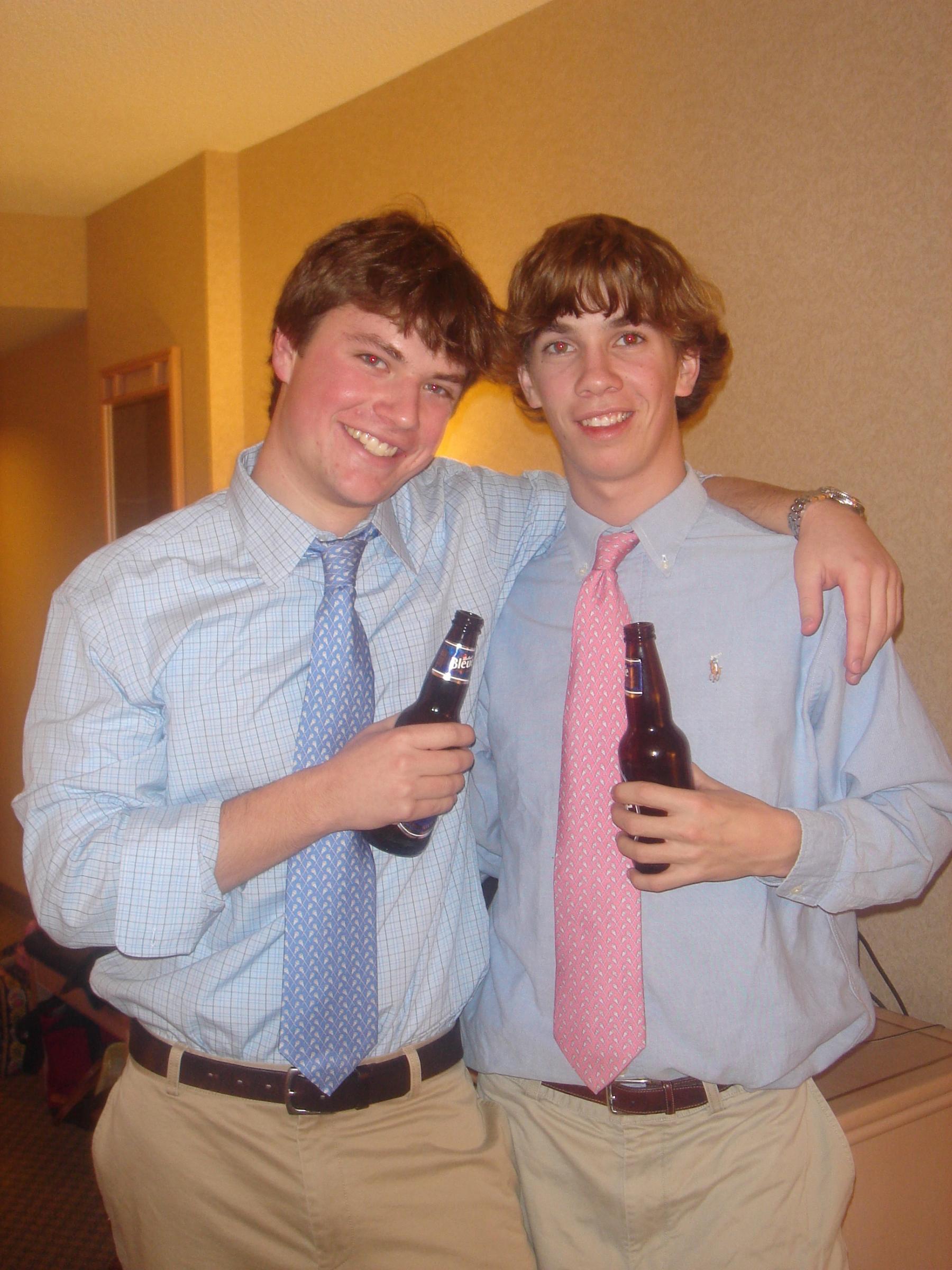
The Vineyard Vines world is populated by people you know doing things to which we can all relate: having weddings and graduations, going to parties and just hanging out with friends.  That life is not only easy to aspire to, it’s tangible and easily made real though you and your best friends all sporting the same Vineyard Vines tie and khakis in that Christmas party picture.  Now that’s aspirational branding.

Wearing the Whale
The brand also fits nicely into the preppy/New England Americana trend that has been evolving for the past few years.  In fact, rather than losing steam the look seems to be gaining, moving into new markets and creating its own subsets of “authentic” work wear, classically inspired sportswear and deeper dives into the prep school ethos.

VV Fans 300x200 Vineyard Vines: An American Original (Part II)The brand also has an appeal that reaches those who will never set foot on the Vineyard and who will never be part of “that” life and the continuing economic downturn provides a silver lining of sorts because customers are drawn to safe, stable, familiar styles now more than ever.

The company’s classic, some say pedestrian, designs will be in style for years and have a certain malleable nature that engages both New England Gold Casters and Southern preps used to bolder color palates.  Typically, Vineyard Vines pieces are not standouts; rather they are good compliments of other aspects of an outfit.  Supporting, rather than starring roles as it were.

Fall 2010 changed up this historical rule however and it seems that Vineyard Vines’ designers were looking to the highly stylized designs of Ralph Lauren’s Rugby brand for some inspiration.  Mild compared to Rugby’s hyper prep school look, but still a noticeable uptick on the style front.

VineyardVines2 300x200 Vineyard Vines: An American Original (Part II)For some then, the traditional designs of Vineyard Vines shirts, pants and shorts represent stylistic security as well as comfort. As an OTC reader one observed, Vineyard Vines is no Ralph Lauren. While the two share a seaside/preppy/windswept lifestyle brand, Ralph is champagne and oysters, Shep and Ian are Sam Adams and lobster rolls.

The brand has never been about highbrow, but it does appeal to the lifestyle sensibilities of many who want some of the privileged coastal life. Functionality plays role as well. A Vineyard Vines polo, tie, fleece jacket or classic “bare feet” D-ring belt will be in style now, a year from now and probably 10 years from now.

Their tote bags have become, especially for many young women, signature accessories. Other items like blazers, oxfords, shorts and pants all reinforce the Vineyard Vines lifestyle without the overbearing brand association of a Ralph Lauren-like status issue. The message is often that if you are a Vineyard Vines person, you are a fun loving low key brand ambassador who doesn’t need go out of your way to impress others.

Washington, D.C., has also found the brand to be a good fit. Apart from its appealing natural heritage and traditional preppy theme, there is a long running and bipartisan relationship that politicians, particularly from the Northeast, have with Vineyard Vines ties.

VV Obama Tie 300x217 Vineyard Vines: An American Original (Part II)During his 2004 presidential run, Senator John Kerry (D-MA) commissioned blue donkey ties for his staff which quickly attained must-have status. Since then, Vineyard Vines ties and belts sporting donkeys, elephants, and American flags regularly dress up blue or red political operatives from Capitol Hill to K Street.

For then-Senator Obama’s 2008 presidential run, Vineyard Vines came up with Capitol Domes and the Obama “O” logo on the tail.  Is there a now a White House version?  Hmmm, I’ll have to check on that.

Even those classic Vineyard Vines totes have been tricked out with blue/donkey or red/elephant trim – my direct observation showing this item to be a perpetual de rigeur accessory for Hill interns and staff alike.

The Business of Fun
From a purely business perspective, Shep and Ian are pretty smart guys. They understand the power of branding and customer association to the Vineyard Vines island lifestyle. They are heavily involved in non-profit, good will and social activities in many of their key markets. The brothers understand the financial and marketing benefits of letting their brand grow organically and in markets that make sense.

VV Sox Tie Vineyard Vines: An American Original (Part II)One of those markets is corporate branding. The company produces neckties and select garments and accessories for the National Football League and  Major League Baseball.  Where one might typically expect to see repeating sailboats, instead team logos scroll across ties.

In announcing the NFL deal several years ago, SportsBusiness Daily, quoted NFL Vice President of Consumer Products Susan Rothman saying, “we have ties in the market, but they don’t have the quality that Vineyard Vines has.” She went on to say that additional team branded Vineyard Vines products are a logical next step.

In addition to its collegiate and professional sports business ventures, Vineyard Vines provides an extensive corporate branding service that captures lucrative company contracts for employee polos, fleece, etc., and corporate gifts, like tote bags, hats and jackets.

Vineyard Vines TP Tote 300x223 Vineyard Vines: An American Original (Part II)Cashing on on the blog-fueled interest in TRUE PREP, the long-awaited follow-up to The Original Preppy Handbook, the company partnered with author Lisa Birnbach to play host to a national book signing tour and produced a capsule collection of TRUE PREP branded product.  the move garnered attention from multiple quarters and also positioned, or re-positioned if you will, Vineyard Vines as a classic brand equal to L.L. Bean when it comes to its preppy DNA.

Minding The Store
Vineyard Vines has taken a creative approach to its retail outlets as well. The company makes a concerted effort not to cannibalize existing retailers whenever possible. In many cases, they actually partner with their existing retailers in developing a new stand-alone Vineyard Vines store.

This strategy captures local market knowledge and existing customer bases, engenders goodwill with their local partners and consolidates retail channels. It also frees up the corporate team to focus on product development and branding efforts.

vineyard vines store large 300x200 Vineyard Vines: An American Original (Part II)The company has won numerous awards, including being named a 2008 All-Star Awards winner by Apparel Magazine for outstanding achievements in the apparel industry. Though it certainly has its detractors, Vineyard Vines continues to be a case study in creating and building a passionate and successful business.

The company also invests in robust back office and supply chain management software.  Controlling costs and inventory across the various retail platforms (web, catalog, company store and retail) is just as vital as customer development.

Vineyard Vines’ website is regularly refreshed, while still retaining it’s clean and brand-appropriate friendly feel.  Though relatively new, the company’s blog, “The Vine” is refreshingly non-corporate feeling.  An active Twitter feed and Facebook fan page round out a robust if relaxed social media platform.

If there is an area of legitimate concern regarding Vineyard Vines’ brand, I think it is the issue of brand dilution. By moving into so many tangential markets – collegiate, fraternal, club, professional sports, corporate – the Murrays do run the risk of muddling what Vineyard Vines really means. If I can pick up a dozen San Francisco 49ers Vineyard Vines ties at Marshall’s for $12.99, exactly how special is that brand? What lifestyle am I really buying?

It’s a legitimate concern and frankly one I suspect has already been mulled over up at the Stamford, Connecticut, headquarters.

Target Pop Up Store In Georgetown

IMG 4207 2 Target Pop Up Store In GeorgetownTarget just opened its cool little pop up store in Georgetown today, at the corner of Wisconsin and M Streets.

Target has squeezed a custom designed mini Swiss chalet into the parking lot right next to Old Glory (great place to stop for lunch by the way).

There are only three of these pop-up stores in the entire country – San Fransisco, New York City and here in Washington, D.C. It runs for only three days and then, it’s gone. So make sure to swing by and check it out. Also, if you follow their Twitter feed, you’ll get clues for the Target Gift Tag Hunt to win gift cards worth $100, and even on worth $500.

Sure, you can pick up a neat little Billy Kirk wallet over at ACL’s occasional pop up flea – but for the next three days you can get your hands on a limited supply of Target’s top holiday 50 gifts. Everything is pre-wrapped and ready to go. When you arrive, you are handed a clipboard printed with images of all the items, organized in nice, orderly fashion. The “store” is basically a huge glass case stocked with numbered examples of all 50 gifts, so you can see them in person. Make you picks, walk over to the bank or registers, pay and you are ready to go.

Products range from the new Star Trek movie DVD to a mini Margarita kit to a quilted bathrobe to a new Wii Fitness Pack. Some of the items are so exclusive to this project that they aren’t even in regular Target stores yet. Whatever price point you have in mind, they can probably cover it.

I stopped by for yesterday’s press event and was really impressed with the whole operation. Staffed by Target employees from both the home office in Minnesota and local stores across our region, the pop-up Target has a fun, seasonally festive feel to it.

It’s cold out right now, so make sure to stop by the pink Curbside Cupcakes truck for a awesome cupcake and hot chocolate.

Tagged with:
 

The Brand of You (Part 1)

Canali+2008 The Brand of You (Part 1)Brand allegiance is a funny thing.

When it works well the customer clearly and deeply identifies with the brand. When it doesn’t work, more specifically when the brand lets the customer down in some way, the old loyalty can be almost impossible to win back.

In menswear, brand loyalty has historically been a deep seated thing. While women are still targeted by designer trends, men traditionally stick with a brand they like and trust. Over the past few years, designers and marketing departments have been working overtime to encourage men to think more like women – season to season, for example. Thankfully that tactic has not been too successful.

Ultimately though, that all matters less and less because of what happened during last year’s holiday shopping season. When the luxury retail economy collapsed along with everything else, the jig was up. In less than one year, the very concept of brand loyalty and even the basic thought process of how a consumer sees their favorite brand, logo or company had dramatically changed.

The Crash of Mass Couture
It all started with Saks Fifth Avenue.

There were already fears about economic problems in the months leading up to the 2008 holiday shopping season. But as Black Friday rolled around, the retailing earth shook when, without any pretense or warning Saks, the bastion of luxury retail, preemptively slashed prices on designer clothes by 70 percent.

This was unheard of; the designers from whom Saks Fifth Avenue purchased the high-end goods were caught totally off guard and other major luxury retailers were forced to quickly follow suit. Soon after, boutiques and then second tier retailers were forced to massively reduce prices.

A cardinal rule of luxury retail had been broken and overnight already skittish consumers were suddenly wondering if their Louis Vuitton bag or designer jeans were ever worth what they had paid only the day before. (The text of the original WSJ article on this fascinating story and reader commentary can be found here, courtesy of StyleZeitgiest.com)

What occurred next was nothing less than a reshaping of the luxury landscape. Saks had correctly surmised that this was the last hurrah of the luxury-for-all boom years and acted in an appropriately dramatic fashion to try and salvage what sales it could from a rapidly deteriorating market. The rest of the high-end retail universe soon saw the writing on the wall and slashed their already low holiday sales prices to the bone and prayed for the best. Then they slashed again.

For many consumers, the magic was gone; the spell of mass-market exclusivity broken. The value that customers saw in their luxury goods – clothing, accessories, watches and even automobiles – was now being questioned. What is the real worth of my Gucci briefcase?

It was bad enough that mass-luxury retailers like LVMH Louis Vuitton Moet Hennessy, Gucci, Coach, Prada and even Tiffany & Co., had diluted their luxury status by aggressively courting middle class consumers with mid-priced products to drive their incredible growth. Now, they were no longer luxury brands, they were more like luxury image brands.

In a race to capture aspirational money, these companies had targeted average folks who wanted to live slices of the high life by way of expensive accoutrements. In doing so, many left disillusioned the truly wealthy who had helped build up the brand’s cache to begin with.

When the bottom fell out of the retail market, all those teenagers and newly minted MBAs (e.g. those who acted wealthy because they could float a luxurious life on credit) vanished overnight. Just like that, the plastic powered cash cow of mass luxury stopped spending.

Then the other hand crafted cordovan slip-on dropped. As the economic tsunami kept on rolling it ultimately pulled under a formerly recession-proof demographic: truly wealthy people. They may not all be broke, but they sure stopped spending. When people who are actually rich stop buying things you know it’s bad.

As the dust continues to clear only one brand name luxury label remains relatively unscathed – Hermes. The company, while always appreciating and welcoming their less than moneyed customers, never changed its brand or marketing to exclusively attract them.

Hermes Paris+Logo The Brand of You (Part 1)
A brand that did not compromise

Hermes is unabashedly a luxury brand and has never apologized for it. This kind of loyalty to their primary customer base, those with disposable cash money, has helped the company remain relatively secure during this period of upheaval.

In fact, while its peers’ profits are firmly in negative territory, Hermes first quarter sales have already grown by 3.2 percent. And the added benefit of Hermes never embracing “logoed” retailing is paying dividends because it is now considered unseemly, should you have the money, to flaunt designer brands. A Hermes bag, though prohibitively expensive, is luxuriously devoid of logos or even a nameplate.

Hermes, therefore, is able to thrive in this downturn because its obsessive focus on quality, honesty and value (at least to those who can afford its offerings) was always true to the brand. It never lost its mystique, the most valuable asset of a luxury firm.

For all those other brands that had heretofore defined the lives we all were supposed to want, everything had changed. They suddenly looked jaded and false, pretentious and gaudy. In the blink of an eye everyone realized that they had been living in someone else’s marketing plan.

Without those bands and their worlds to define us, how would we now define what brands meant to us?

All About “You”
It turns out that many smaller and specialized brands had been waiting for their shot at the brass ring. At the same time, people began to turn away from mega brands and finally think about what message they were telegraphing about themselves. As they looked around, they began to see other options in design, craftsmanship, cost, style and quality.

Those global brands, while still important, had lost much of their mystique. Luxury prices had been grossly out of whack if only because we kept paying them. No longer did we want the “it bag” or “it shirt” just because a glossy ad said we should. Simplicity as a value was taking hold.

Enduring style and expressing personal taste became cool. As consumers now look for the local and unique, for things with long lived value, craftsmanship is again becoming prized. And that goal of simplicity does not mean cheap or disposable; quite the opposite. At its core, the emerging argument is that if I’m going to buy something expensive and luxurious, I want it to be unique and hand crafted. Instead of five “luxury” off the rack suits, I want one or two custom suits that will last for years.

My things now need meaning and need to fit me, not the other way around.

With consumers taking over the job of promoting or dismissing luxury goods via blogs (like this one), twitter, rating sites and simply by communicating with each other and bypassing traditional advertising altogether, the definition of branding is changing as well.

6058Ian2web The Brand of You (Part 1)
Your personal style is now your logo

In fact, it seems that now we’re the brand. Designers and marketers are looking for ways to get their products associated with people. It’s not just about us wanting to live in their worlds, now they want to be worthy of our personal brands.

It’s now about the brand of You.

The second half of this essay will discuss how these changes have turned the concept of branding on its head. So stay tuned for part two.

To us here at OTC, this is an evolving analysis on the rapidly changing landscape of branding and retail, and the pendulum swing of influence from marketers to consumers. Please feel free to comment on this essay and add your own thoughts.

Tagged with:
 

Going Custom – Part 2

4 Final+Steps Going Custom   Part 2I wanted to give everyone an update on the progress of my VM Clothiers custom suit. I am very happy to say that it is now in my hands after being literally hand carried back from Hong Kong. Part 1 of this series can be found HERE.

I’m now in the process of putting it through a few real-world workouts. Overall, my immediate impression is a good one and I am very happy with the quality, fit, feel and construction.

I’ll get back to you with a more detailed review, but first I’d like to share some great pictures of the suit taken as it was being constructed in Hong Kong.

All of these images are courtesy of Vishal Mirpuri, owner of VM Clothiers.

1 Cutting4 Going Custom   Part 2
My suit’s stencil

First, a stencil is created for each individual panel of fabric that will be sewn together. The stencil is based on the measurements and instructions taken from the suit’s order form. Order forms tend to be very detailed as there are so many variations available to the customer. They can range from basic options like single or double vents to exotic interior pocket configurations.

2 Cutting7 Going Custom   Part 2

2 Cutting5 Going Custom   Part 2

They then
cut the individual panels of fabric using the stencil. Each customer’s stencil is kept on file for future orders.

3 Sewing Going Custom   Part 2

Once the primary pieces of the garment are assembled, the master sewer takes over and begins the exacting process of sewing the jacket together. This includes major tasks, like sewing the arms to the jacket’s body and more detailed work, like creating button holes.

After the jacket is sewn together, finishing touches are made, including setting the jacket’s final shape. The photo at the top if the page shows this stage. The white basting thread is left in place until the jacket is ironed into shape.

5 QC Going Custom   Part 2

Above, you see the tailor making some final adjustments during a quality control review. Each suit is inspected to ensure everything has been done correctly.

This is the point when it all comes together – measurements and construction, balance, details, style and the many unique variations that make a custom suit “custom”.

6 Finished+Suits Going Custom   Part 2
A rack of finished suits

Tagged with:
 

The Challenge of Branding Real Life

Marthas+Vineyard+Beach The Challenge of Branding Real LifeAn anonymous gentleman posted the following comment about the recent “Vineyard Vines” column.

He raises a very interesting point and I quickly drafted three paragraphs in response. So, instead of overloading the comment screen, I decided that a more organized response was appropriate.

OTC-

Being a Vineyarder, I’ve always been a little frustrated with Vineyard Vines. Shep and Ian are great guys, I’ve run into them in Edgartown plenty of times and they’re always cordial, etc.

However, VV has exposed and exploited the “Trad” and “Vineyarder” traditions and lifestyle that I’ve held dear. Why do they get to exploit an island that, statistically, the average Vineyard Vines wearer will never visit? Some kid in Ohio buys VV sandals with the towns of the Martha’s Vineyard on them, and that’s supposed to be clever or a good business plan?

I like their stuff and have some myself, however when I see them putting out “cargo-shorts” and goofy sweatshirts, I have to draw a line. They’ve taken it too far, and it’s upsetting.

Therefore, while I understand people’s frustration, I myself just cannot accept a company that blatantly exploits the place I’ve summered all my life.

-Upset

The reader poses an excellent question and I fully understand what he means. Actually, his quandary gets to the heart of what I find so fascinating about brands and marketing.

This sentiment is quite reasonable for someone who feels his way of life, culture or custom is being exploited for another’s material gain. Still, the short answer to his question is that if some kid in Ohio is buying Vineyard Vines flip flops than yes, they do have a good business plan because the point of a business is to sell a product. If they sell a lot of those flip flops, along with polo shirts, duffle bags and baseball hats, than I would say it is a very successful business plan. Of course, that doesn’t mean you have to like it.

I think however that the reader’s issue is not so much with Vineyard Vines’ business plan as it is with what he sees as the commoditization of the Martha’s Vineyard lifestyle. He cherishes what it means to be a “Vineyarder” (i.e., someone who, if they do not actually live there, actually spends frequent time on the Vineyard) and does not like how its distinctiveness has been watered down. Something unique that he loves and values is now accessible to anyone who wants to buy a piece of it.

Marthas+Vineyard+Edgartown+Lighthouse The Challenge of Branding Real Life
Iconic Martha’s Vineyard

At first, perhaps there was a feeling of pride in the company’s initial success. He might have said, “Vineyard Vines, sure I’ve heard of it, summered there my whole life.” Now that it’s a pretty big brand which seems to be everywhere, not so much. Even worse, from his point of view the brand has lost some of its exclusivity since it even shows up at discounters. As JP noted in an earlier comment, the cache has left the station.

But to me that seems to be a rather self absorbed way of looking at things. Vineyard Vines is a business created by two guys who wanted to celebrate the Vineyard/preppy/New England lifestyle. They succeeded and the brand is now widely available to a variety of customers. Just because you are “over” the initial coolness of a particular brand does not mean it is now valueless. And just because it’s no longer the new thing and instead an established brand (the kind of successful problem never achieved by many retail labels) does not mean that it should stop attempting to remain relevant to the market.

Is it an affront to authentic Vinyarders that they have achieved their goal? This is a question that many fact-based lifestyle brands will face at some point. I had my own issue with Polo/Ralph Lauren several years ago. I got over it of course since I went on to work at two Polo stores, managing one of them.

Though by no means the landed gentry, I spent most of my childhood summers at family homes either on the Connecticut shore or in the mountains of Vermont. Many of my relatives (not I, for the curious) attended Ivy League schools and my immediate family has a long affiliation with Yale. We had enough interesting ancestors to provide us with monogrammed silver and several impressive looking portraits – one with a frame large enough to be briefly considered as a possible mantelpiece.

The upshot here is that when I first encountered Ralph Lauren’s world, I thought it was awesome; a perfected version of a certain aspect of my life. I related to the New England preppy ethos behind the brand and identified with his message. However, as the company grew and expanded into every retail and marketing crevice imaginable, I got a bit irritated.

520   article image The Challenge of Branding Real Life
Polo’s Preppy

I felt that he had exploited the regional culture I loved and turned it into a caricature of vain, overly accessorized snobs. These were no longer the people or the rich, cultural heritage I knew. I felt that Ralph Lauren had co-opted a special part of my identity and turned it into just another brand, another ad campaign to sell shirts.

What I felt he disregarded was the very thing I most appreciated; the reality behind the blue blazer-madras-gin-and-tonic-khakis-and-penny-loafers image. That the fancy silver was actually used every day, or that I’ve always had a blue blazer because I was taught to dress up when appropriate. I liked knowing that what we now see as the iconic rumpled preppy “look” came about for a reason – there is an actual history to it. That is what makes the Official Preppy Handbook such a beloved and sought-after book. For those familiar with the subject matter there is a big nugget of truth in there, along with the obvious tongue-in-cheek humor.

Now some kid in Ohio could sport Polo khakis, a Polo polo shirt, Polo ribbon belt and Polo boat shoes and call himself a “Prep.” Anyone, anywhere could. The whole preppy lifestyle seemed a little reduced and shallow.

However, as I got over my own self righteousness I began to see that the Polo brand was in fact celebrating and expanding upon its preppy base. Lauren was not devaluing it; he was embracing it and moving it beyond its traditional regional and cultural boundaries. While not meaning to sound sappy, Ralph Lauren has probably done more to preserve the idea if not the practice of New England/Ivy League/American preppy life than any other brand or modern cultural influence. He redefined, reinvented really, what classic American lifestyle means.

Of course, Ralph Lauren and Vineyard Vines are two very different companies and I am not making a direct comparison. I do not think that Shep and Ian’s brand has had an equally global impact on the perception or “ownership” of Vineyard life.

VV+Edgartown+Store The Challenge of Branding Real Life
Vineyard Vines’ Edgartown Store

But I do believe they had the same intentions in founding their company as as Mr. Lauren did with his: to celebrate a lifestyle they love. The true affection for both these two brands, each built from nothing and with considerable risk, is genuine.

I happen to like the Vineyard Vines brand and what it represents. Though I am not a Vinyarder, I sometimes wish I were and if buying a ball cap with the pink whale logo gives me a small emotional connection to what my reader knows so well, then so be it.

If nothing else, it makes me want to be one of those statistical few to actually visit, stay at a nice B&B in Edgartown, shop and have a cup of coffee while perusing The Martha’s Vineyard Times real estate section.

Tagged with: