Dinner With Jon Green

Jon Green Blazer Depatures Dinner With Jon GreenRestaurant Brio, New York City.

Earlier this year, I was sitting in this outstanding modern Italian restaurant – literally next door to the celebrated David Burke Townhouse (for the foodies among you) -  and indulging in one of the best pizzas I’ve had in a long time.  Actor Ricky Gervais strolled past me on his way to the table overlooking 61st Street.  All the diners stare – some text friends.  Fame by proximity; so very New York.

That Mr. Gervais is decked out in nylon running pants, sneakers, a random jacket and an old – or perhaps “vintage” – tee shirt is apropos given that my dining companion was bespoke clothier Jon Green.

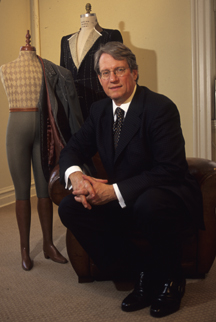
Jon is a remarkable guy, both in personality and skill.  Within a certain circle, he is very much a celebrity in his own right – but he’s not a tailor.  He’s a clothier; a distinction he is always quick to make.  Publicly, Jon is perhaps best known for being profiled by Forbes magazine after once crafting a $25,000 suit.  “Not a particularly practical suit,” he told me.  “The fabric was very expensive and no really conducive to daily use.”

Perceived reputation notwithstanding, Jon is actually a very practical and modest man.  Though always impeccably turned out, he owns only a handful of his own make of suits, along with a few blazers.  A multitude of shirts and selection of neckwear round out his work wardrobe.

Should I even have to mention that, with a starting price of around $9,000, no, I do not yet count a Jon Green bespoke suit among my own wardrobe’s holdings?

Jon Green Fitting2 222x300 Dinner With Jon Green

The level of hand detail in a Jon Green suit is astonishing.

We chatted about a number of things, from his philosophy on dressing well to the possible development of a new, lower-priced line.  All things being relevant, “lower-priced” in this case means in the range of $5,000.00.  He’s a voraciously intellectual guy who is fascinated with everything, not a bad trait when your customers literally include global captains of industry.  He also a counselor and guide, confidant and referee.  Above all he a perfectionist, exactly the trait needed in this highly discerning field.

Jon is a bespoke designer, and that in and of itself is a very specific designation.  The word “bespoke” is derived from the English verb of the 17th century to bespeak, “to speak for something, to give order for it to be made.”

The standards of Bespoke clothing requires the creation of a paper pattern, hand cutting of the cloth with shears, and the highest level and amount of hand, needle, and iron work by a master coat maker, pant maker, and waistcoat maker.  In fact, the cloth used in bespoke is often itself, bespoke.  Jon told me about once traveling to a mill in England to monitor the manufacture of a specific order.

Both made-to-measure and ready-to-wear garments are cut from a ready-to-wear block pattern, with or without alterations, and constructed and finished in the same way as ready-to-wear in a factory.

JonGreenSitting216w 201x300 Dinner With Jon Green

Jon, in his Madison Avenue studio

The bespoke suit is the gold standard of male dress and the suit to which every other aspires.  The process of crafting a Jon Green bespoke suit starts with taking the measure, rather than the measurements, of the man.

It begins with a conversation about the person – his sartorial likes and dislikes, his personal style.  Within the broad traditions of classic tailoring, one can define their own look.  Jon’s goal is not just to create a garment that fits perfectly, but to create a garment that perfectly fits his client.

The ultimate goal, as with other craftsman of his caliber, is to create a lifelong learning experience where the client at first relies on Jon, but comes to trust their own taste the more they learn about what styles suit them best.

Jon is also occasionally asked to provide his sartorial insights to a broader audience – like the discerning readers of Departures magazine.

So, what was Jon wearing at our dinner?  Jeans, navy cashmere turtleneck and a 15-year old blue blazer of his own make – recently re-lined.

He looked great.

Tagged with:
 

Bruce Boyer on Tailoring

Bruce+Boyer3 Bruce Boyer on TailoringRecently, we had a vigorous debate on the merits of custom tailoring. Front and center was the very definition of “custom”; did refer only to completely bespoke handcrafting or could one call made-to-measure and its equivalents “custom”?

Jon Green, the noted bespoke clothier and OTC contributor, sent along the following article written by G. Bruce Boyer. As Jon pointed out to me, this argument on the semantics of what is or is not truly custom has been hotly debated for decades and shows no sign of easing.

Quite to the contrary; with one’s ability to hop online and order up a (possibly) custom suit of clothes, sports jacket, shirt or even overcoat, the rift between bespoke purists and everyone else has deepened even more.

So, with thanks to Mr. Green and by extension to Mr. Boyer, let’s see what the preeminent authority on menswear has to say about this thorny issue.

Bruce+Boyer2 Bruce Boyer on Tailoring

Personal Best
A Slew of Custom Tailoring Choices Adds Up to One Thing: A Suit to Fit Each Individual
By G. Bruce Boyer

Men used to have but one clothing decision: they bought off-the-rack, from a men’s or department store, or had suits custom made by a tailor. Today a panorama of personalized clothing options–bench-made, custom-made, made-to-measure and special order–make the choices wider but a bit confusing.
In an effort to clear things up, let’s define the terminology.

The term bench-made generally indicates that clothes are made in a shop that has the tailor’s name on the door; further, that he is a master tailor (meaning an expert pattern maker, cutter and fitter). The work is done on the premises, an individual pattern is constructed for the exclusive use of each customer, and there is a maximum of handwork.

Most of the same criteria apply to the term custom-made, except that the work is not always done on the premises, and the name above the door is not always that of a master tailor. More often than not, the head of the establishment is someone–such as a designer–whose reputation is based on his taste and who is capable of providing excellent advice.

“Made-to-measure” clothing differs from bench- or custom-made apparel in that tailors use stock patterns that are modified to fit an individual customer. Construction and fabrics of made-to-measure garments may be of very high quality, but, because no individual pattern has to be created, prices can be considerably less.

“Special-order” suits (which we will not cover beyond this point) are made from unaltered stock patterns, but offer a selection of fabrics stocked by the manufacturer and a choice of two or three basic style models. The customer usually pays a premium of 10 percent. The procedure for the customer is much the same whether the construction is bench-made, custom-made, or made-to-measure. All three processes afford measures of personalization and individuality that are otherwise unavailable.

Bruce+Boyer1 Bruce Boyer on Tailoring

First, styling–which includes general silhouette and specific details–is discussed. The customer will be asked if he favors a built-up look or a more relaxed one. Italian, English or American interpretations are typical options. Of course, the customer’s preferences for fit and feel are also solicited: For example, will the jacket and trousers sit close to the body or have an easier, fuller fit? Does he prefer a higher or lower shoulder? Will the jacket have a soft or firm feel?

The customer chooses the basic form–single- or double-breasted, two-button or three. From there a plethora of details can be ordered. Should the jacket be side, center or unvented? Will the customer prefer flapped, besom, patch or hacking pockets? A ticket pocket perhaps? How many buttons on the sleeve (with working buttonholes, of course)? How many interior pockets? Lapel width or trouser rise may be an issue.

The trousers type must be specified. Will they have pleats or plain front, cuffs or plain bottoms? On-seam or off-seam side pockets, and how many back pockets? A change pocket, a watch pocket? Swelled side seams? Self-supporting waist, belt loops or suspender buttons? Then there is fabric selection. Any reputable shop will have dozens of swatch books from which to choose hundreds and hundreds of cloths–everything from traditional worsteds, flannels and tweeds to the Super woolens (starting with the Super 80s and going up to the 180s), fine silks, cashmeres, cottons, linens and blends. Lightweight fabrics are those considered to be between 7 and 9 1/2 ounces, medium are between 10 and 13 ounces, and anything over 14 is considered heavy in our climate-controlled age. [See Cigar Aficionado, Summer 1995, for a discussion of fabrics.]

Some tailors will have cloths woven exclusively to their own requirements of weight, pattern and color (often their names will be woven into the selvage–the outside strip of the cloth–as proof of exclusivity). Others simply have an eye for that odd bolt of cloth they know their customers will appreciate.

Finally, the tailor will take the measurements. Here’s where the best shine: meticulous measurements make for a suit that fits. Which is why a good tailor will leave nothing to chance. He will want to measure the length of each arm and each leg separately, the chest under and over the arms, the waist above the hips and the seat below them. He will want to measure the shoulders from one side to the other (called “point to point”), and each one from the middle of the back. He will measure the length of the coat that the customer is wearing (only as a rough guide).

The tailor will measure a variety of points on your body that you never thought had anything to do with each other. All these numbers will be recorded in the order book. Your fitter will note, in his own shorthand system, any little problems or idiosyncrasies your body might have: “EP” might stand for erect posture, “LLS” for lower left shoulder. But never mind if your neck is like a corkscrew, your calves protruding, or your back like a dowager’s hump. A good tailor is part psychologist, part cosmetic surgeon. With a little nip and tuck of the cloth here, a bit of extra padding there, some slight narrowing of the trouser leg or widening of lapel, veritable miracles can be performed. (A practical note: it’s a good idea to wear the same sort of shoes and shirt while being fitted as you’ll match with the clothes being made, since this makes measurements more relevant to the way you actually wear your clothes.)

Before departing the shop you will be asked to leave perhaps a 50 percent deposit, and be given an assurance that you’ll be called in several weeks’ time–say three to six–for a fitting. Bench- and custom-made usually require two or three fittings (the first fitting is merely the shell of a garment), while made-to-measure usually requires only one (for minor alterations, button placement and a few minor details).

During the remaining fitting(s) the garment will be fine-tuned, a quarter-inch chalked off in one place, an eighth added in another, a notation made to ease an armhole just a fraction, or minutely tighten the trouser seat. Button stance will be decided. It’s a good idea at this fitting to transfer anything you carry in your pockets to your new clothes, so any adjustments for a bulging wallet or eyeglass case can be made.

The suit should now be properly balanced (each part being where it should be, and sitting correctly) and comfortable. The buttonholes can now be cut and buttons attached. After a final hand-pressing, the suit will be shipped. The record of the measurements (in the form of a paper pattern for bench and custom), tailor’s notes for alterations, and perhaps a small swatch of the selected fabric will be filed away for future orders. Figure on six to 10 weeks from order to delivery.

Personalized clothing is a true investment. Treated with respect and proper maintenance, it will more than pay for itself. A cheap suit looks cheap even when it’s new; a good one looks great even when it’s old.

Tagged with:
 

Indochino: Going Online to Get Custom

Indochino Indochino: Going Online to Get CustomLate last year Kyle Vucko, one of the co-founders of the online custom tailor Indochino, contacted Off The Cuff about reviewing one of their suits. I had heard of the company and read about their innovative business model in the Wall Street Journal. I had also read some other reviews, all of which generally have a positive bent.

After chatting at length with Kyle about the ordering process, reimbursement of follow-up tailoring expenses and their total satisfaction guarantee, I agreed to give it a try.

Indochino donated the suit to OTC, so it cost me nothing; however there still aren’t too many places where you get a custom suit for around $400 dollars in less than a week. I chose a navy two-button, notched lapel, single breasted suit with double vents. I also added pick stitching, surgeon cuffs and purple lining.

Indochino+Blue2 Indochino: Going Online to Get Custom
The suit, yes. Me, no.

The online ordering process is very easy, though it takes longer than you might think to actually take all the measurements – and you definitely need someone to take them for you. In my case it was a very patient wife. If you need help along the way, each step has a short video to walk you through the process. Once you are done, your online profile can be used to speed you through future orders.

The suit arrived very quickly, in less than one week. Given that it was made in Shanghai, that’s pretty impressive. I suspected that the likelihood of it fitting perfectly right out of the box was slim, and it turns out I was correct. The collar was way off – the result of a tight fit across the shoulder blades – and the pants’ waist too big. I took some pictures and e-mailed them off to the company. After a quick consult with the Indochino tailors a new suit was cut and whisked off to me. The new one is pretty much perfect and I wear is regularly.

Though I have not yet ordered another suit, I can always keep my measurements and preferences up to date in the online profile. While I look forward to the day that I can go to OTC contributor Jon Green for a bespoke suit, I am happy to say that my Indochino suit is very comfortable and regularly garners some darn good compliments.

You should note that their basic cut is clearly modern: shorter jacket, trimmer fit, 18-inch leg openings, narrower lapel. That said, you can alter and tweak pretty much anything to your preference. I am not a 20-something – not even a 30-something anymore; and that is their target demographic. So, I took some time and modified the suit to fit my frame and desired look, and it works on me. Without a doubt, I will be adding to my Indochino wardrobe.

Indochino is not competing with Savile Row or even the Ralph Lauren’s of the wardrobing world. For some, these are clearly “starter” suits or fashion suits for the post college crowd. I take a different Instead approach – I think Indochino can make suits cool again for men who like clothes. My suit looks current, yes; but by no means is it overly modern. It is well made and will last for many years in both style and construction. More importantly, I can easily choose, customize and purchase a new suit in a very short amount of time at a very economical price. As a result, to me, my suits are no longer only for important meetings or getting dressed up. They can be a more integral part of my wardrobe.

I can order a couple of casually designed suits as well as several formal models for a relatively modest investment. I can make the suit part of my own signature; with or without a tie, cap toe dressy or Todd’s moccasin casual. Indochino opens up interesting new possibilities for men; possibilities that did not previously exist at this price point.

By no means will I abandon my local custom tailor, VM Clothiers; I see them as two very different resources. And Jon Green can sleep easy – he won’t lose any clients. But a new door is being wedged open and the Indochino team rightly sees a lot of potential upside.

Indochino+WS Indochino: Going Online to Get Custom
Wall Street Collection

Having a love of clothing and classic style should never preclude you from going online to track down new options and new resources. Whether it be Rugby.com to design your own custom rugby shirt or Indochino and a new suit from their very sharp and recently launched Wall Street Collection.

Below is a brand new video from Indochino showing how they make their suits – from the initial online order to the finished product heading off to the office. It’s very well done – take a look. By the way, the gentlemen you are about to see are not actors, they are Indochino’s master tailors, and yes, they really do dress that way every day. You can also find the video on their You Tube channel HERE.


Tagged with:
 

OTC Exclusive: Jon Green

OTC+013 OTC Exclusive: Jon GreenJon Green loves to talk about clothing. Actually, he just loves clothing. In fact, I would suggest that Jon is obsessed with clothing and given his profession, that’s definitely a good thing.

As one of New York’s finest bespoke clothiers, if not the country’s, Jon Green is privy to the wants, demands, preferences, problems and personal trivialities of some of the wealthiest people in the world.

I try not to throw around such dramatic language too often, but in Jon’s case it is simply the truth. Jon’s suits start off at about $7,500 and go straight up from there. Add in some of the more luxurious and rare fabrics to which he has access and you’re looking at something touching $25,000.

OTC+019 OTC Exclusive: Jon Green
Jon Green

Had you asked me a few weeks ago what I thought about dropping the cost of a new car on a single suit, I probably would have said something both unflattering and dismissive. Not only is that a lot of money, what possibly could go into any garment which warrants such a ridiculously high expense?

Then, as fate would have it, I was recently invited by Mr. Green to visit him while on a trip to New York. Let me just cut to the chase: I’ve drunk the Kool-Aid and joined the church of bespoke.

Past the deceiving simple paper sign on the building’s front door, the elevator took me up to an elegant salon and tailor’s workshop. It is a place of business but also of consul; a comfortable lounge filled with mannequin forms sporting suit jackets in various stages of completion and bookcases filled with fabric books. Up front is the tailor’s workshop fronted by a bank of large windows overlooking Madison Avenue and capturing all the natural light.

OTC+014 OTC Exclusive: Jon Green

Jon won me over without even trying. Unfortunately, I won’t be wearing a Jon Green suit anytime soon, but that’s not remotely the point. The world of bespoke – certainly at this level – changes how you think about clothes.
As Jon noted, “The price of what we do is directly related to our costs of cloth, workmanship, location and the one-on-one personal attention we prefer to provide our clients. This includes the requisite number of fittings needed to ‘get it right,’ not just ‘get it out the door.’ The real value in bespoke clothing is enhanced by taking the time to get it as good as it can be. But then forgetting about it. After all, it is possible to polish a diamond to dust.”

OTC+027 OTC Exclusive: Jon Green

As an added bonus, I visited Jon at the same time as Dougal Munro and Malcolm Campbell from Holland & Sherry, the Rolls Royce of fabric makers. Dougal is the president of H&S’s North American operation and Malcolm is Managing Director of Joseph H. Clissold, H&S’s premier fabric mill. Our discussion about English fabrics, their role in the world of bespoke, and H&S’s remarkable innovations was fascinating and one that a that I will document separately, along with some excellent H&S material covering fabric education and the impact of color on one’s wardrobe.

OTC+026 OTC Exclusive: Jon GreenOTC+032 OTC Exclusive: Jon Green
Malcolm Campbell (t), Dougal Munro (b)

A formally trained musician and clothing salesman, Jon is
every inch the courtly clothier. He is not, however, a “yes man” arbiter to wealthy power players. As he said to me regarding a client whose requests were not representative of a Jon Green suit, “it’s my suit until I hand it over to him.” Translation: we’ll work it out, but I have a reputation to uphold and there is an expectation of what a Jon Green suit means. No animosity, simply a standard of excellence and detail that is not quickly, or easily, bent.

However, Jon rarely needs to take such a stand. His clients are lovers of clothing and dress for themselves. They come to Jon because he is the best and that is what they want; they have found a friend and confidant who will do anything in his power to meet their needs and will also not hesitate to gently redirect an errant choice in fabric or customization.

As he explained on several occasions, Jon is not a tailor – he is a clothier. While the tailor with whom he works is clearly one of the finest, Jon brings to the engagement the vision and execution of a head coach or chief strategist. He has created a brand known to those for whom exceptional service, privacy and collaboration are paramount.

Jon is, at heart, a teacher. While we never really discussed the cost of his clothing (honestly, it just slipped my mind), he indirectly explained why his suits cost so much. Every inch of a Jon Green suit is hand cut and assembled. Pockets are fully fitted into the canvas body which itself is carefully formed to your body’s curves.

bespoke OTC Exclusive: Jon Green

The entire jacket is basted until the final assembly – no finishing stitches anywhere. This means that throughout your initial fittings, often six, the suit is completely disassembled and re-cut to match your evolving pattern. And your pattern, hand drawn by the way, is hand updated by the tailor at each step. It will take months and once completed will fit you as well as humanly possible.

Will it be perfect, probably not to Jon. But that is part of the beauty of bespoke – it is hand crafting in every sense of the phrase, not a single shortcut or prefabricated piece of anything. And all that hand stitching! That alone is worth half the cost right there.

madison avenue OTC Exclusive: Jon Green

Overall, the entire process is so laborious and detailed that I can only describe it as art. Jon and I could have talked for hours; he’s a fascinating and incredibly knowledgeable man.

Jon has been selected to by Louis Vuitton Moet Hennessey North America, as part of a celebration of American craftsman, to create a bespoke suit for its chairman, Renaud Dutreil. I’ll be updating you on this remarkable process as it moves along, the only menswear blog to have such remarkable access.

Renaud+Dutreil,LVMH+Bike OTC Exclusive: Jon Green
Msr. Renaud Dutreil

I am also happy to say that I’ll be working with Jon to periodically bring OTC’s readers the kind of insight and expertise normally reserved for captains of industry and the kind of men who hop thier private jet from Houston just to do a suit fitting. Jon is a wealth of information and OTC is both honored, and a little humbled, to call him a friend.

Stay tuned…

Tagged with:
 

Ciff+%281%29title Cifonelli: Bespoke in the 21st Century (Part I)Off The Cuff is honored to welcome Hugo Jacomet, founder of the incredibly stylish blog Parisian Gentleman, to the States.

Hugo will be an occasional guest contributor here at OTC and I will likewise offer the men of Paris OTC’s modern take on Ivy League East Coast classics.

So, without further ado…

There is no doubt that legendary tailor Cifonelli has an exceptional story to tell. There are two main reasons why this family business is so unique – really the only one of its kind.

First, there is the unique style of their creations (and creations they are: client after client, suit after suit). Each one displays a unique blend of typically British strictness and Italian creativity, topped with a quality of finish à la française. Such “fusion”, unique in the sartorial art world, is in the DNA of this traditional label whose style is far more eclectic than its name at first glance would suggest.

Then, there is the family history of a house still 100% in the (expert) hands of its 4th generation, steering the company through its transformation from confidential bespoke workshop for insiders into world class luxury brand. The family has accomplished the feat of passing on its savoir-faire to next generations without giving in to big luxury conglomerates. The family has also resisted the temptation to promote (or bank on?) its famous name through mass distribution, unlike what is done by some tailors of the Row, such as Henry Poole expanding in China and beyond.

One might suggest that the “marketing of tradition” has become essential for any enterprise with a specific know-how. Several tailoring houses have a narrative that tells of a savoir-faire passed down from distant generations. Dozens of label names end with the very popular “& Sons” while an increasing number seems to have been “founded in 1860”, a historical claim that can go unchallenged. Let’s just make it clear that Norton’s son doesn’t work for Norton & Sons and that there are no Andersons or Sheppards cutting for Anderson & Sheppard.

Let’s take another example from Italy: Domenico Caraceni founded the famous Caraceni house in Rome in 1913. Then conflict tore the next generation and brought the family to the absurd point that it has reached today. Brace yourself: aside from the (small) original shop that is still up and running in Rome, there are no less than three Caraceni shops (held by “dissident” Caracenis) posing as the “real” Caraceni house. Insiders say that it is the A. Caraceni shop, owned by Mario (Domenico’s nephew) in Milan, which is the truest to the family heritage. Complicated, isn’t it?

The Cifonelli family history reads like an epic saga, resembling few others, especially in the second decade of the 21st century. Unlike families we’ve already talked about, the Cifonellis preserved their history and passed it down from one generation to the next. Hence, the Cifonelli house might have become the only bespoke house in the world where you will always be greeted by a family member. Say hello to Lorenzo and Massimo, 4th generation Cifonellis, a name that goes hand in hand with the art of being a tailor.

The house was founded (for real!) in 1880 by Giuseppe Cifonelli, who first set up his workshop in Rome. His son, Arturo, expanded the business and will forever remain the soul of the style and the true artist of Cifonelli.

Very soon, Arturo was sent by his father to London to be trained in the art of cutting at the very proper “Minister’s Cutting Academy”. His diploma is dearly held in the shop rue Marbeuf (pictured below).

diploma+%281%29 Cifonelli: Bespoke in the 21st Century (Part I)

The Cifonelli style, a clever blend of British strictness and beautiful Italian lines, is shaped and developed by Arturo in his first Paris workshop. One opened in 1926 on Rue Courcelles and the second, still standing at the center of Paris’ golden triangle, was inaugurated in 1936 at 31 rue Marbeuf.

Slowly, Arturo began to gather a client base of demanding and elegant connoisseurs. His excellent reputation grew as more and more famous politicians and artists start wearing his amazing bespoke suits. Arturo was often described as demanding, uncompromising and passionate. He was both loved and feared by his workers who, legend has it, made the sign of the cross before sending him a suit for final inspection. If he didn’t like it, it could be cut all over again and started from scratch…

When Arturo died in 1972, his son Adriano took over and carried on developing his father’s work until the beginning of 2000. The Cifonelli reputation slowly started to spread outside of the closed circle of stylish and wealthy gents. True, the most famous ambassadors for Cifonelli always had quite a bit of panache: Paul Meurisse, Lino Ventura, Marcello Mastroianni and, most importantly, François Mitterrand (whose Cifonelli collection was recently auctioned at Druot). Notably, between 1992 and 2007, the Cifonellis also made all the bespoke suits for Hermes (1992-2007).

mitterrandcifo Cifonelli: Bespoke in the 21st Century (Part I)

In the early 1990s, Lorenzo (Adriano’s son) and Massimo (Lorenzo’s cousin) truly enter the business, after spending their youth around bundles of fabrics, pattern paper embossed with luxury stamps, watching workers hand stitch most utterly perfect Milanese button holes.

lorenzotailoring Cifonelli: Bespoke in the 21st Century (Part I)

massimocut Cifonelli: Bespoke in the 21st Century (Part I)

In 2003, the two cousins officially took control of the bespoke workshop at rue Marbeuf. In 2007, they developed an exacting made-to-measure line and opened a RTW storefront right below the original workshop.

At that time, two important events proved the Cifonelli commitment to perpetuating their sartorial expertise; such skill had been put under considerable threat in other labels (including on the Row). This threat was brought on by an aging workforce (on Saville Row, über specialized workers can be much older than 75).

The first of these two important events occurred in 2000 when Cifonelli acquired Claude Rousseau’s workshop (and its workers). The second was the 2008 purchase of another famous Parisian tailor’s shop and staff, Gabriel Gonzalez. If you are familiar with the small world of (very) high level bespoke houses, you understand the importance of these acquisitions, that successfully brought back together, under the Cifonelli impetus, the legendary Camps de Luca team, 30 years later after its separation (when Mr. Camps was at the helm). Back then, the team had Smalto, Rousseau and Gonzalez on board. Talk about a dream team!

Lorenzo credits Claude Rousseau, who has since retired, for teaching him the extreme art of detail and an obsessive care for finish. Gabriel Gonzalez still works on rue Marbeuf, as passionate as ever about tailoring despite being 72 years old.

gg Cifonelli: Bespoke in the 21st Century (Part I)

Parisian Gentleman was delighted to be welcomed into the Marbeuf workshop. In the next installment you will be able to read our long interview with Lorenzo Cifonelli, who talked about the Cifonelli style (and its famous shoulder), of its obviously renewed clientele, of development projects for Japan and the United states.

lorenzoitv1 Cifonelli: Bespoke in the 21st Century (Part I)

Everything you always wanted to know without daring to ask on this amazing international bespoke institution.

As a side note, should you be in New York City next Monday or Tuesday, January 11-12, you may wish to stop by the Plaza Athenée Hotel at Madison Avenue and 64th Street to personally visit with Lorenzo Cifonelli himself.

Isn’t it exciting?

Cheers, HUGO

Tagged with: